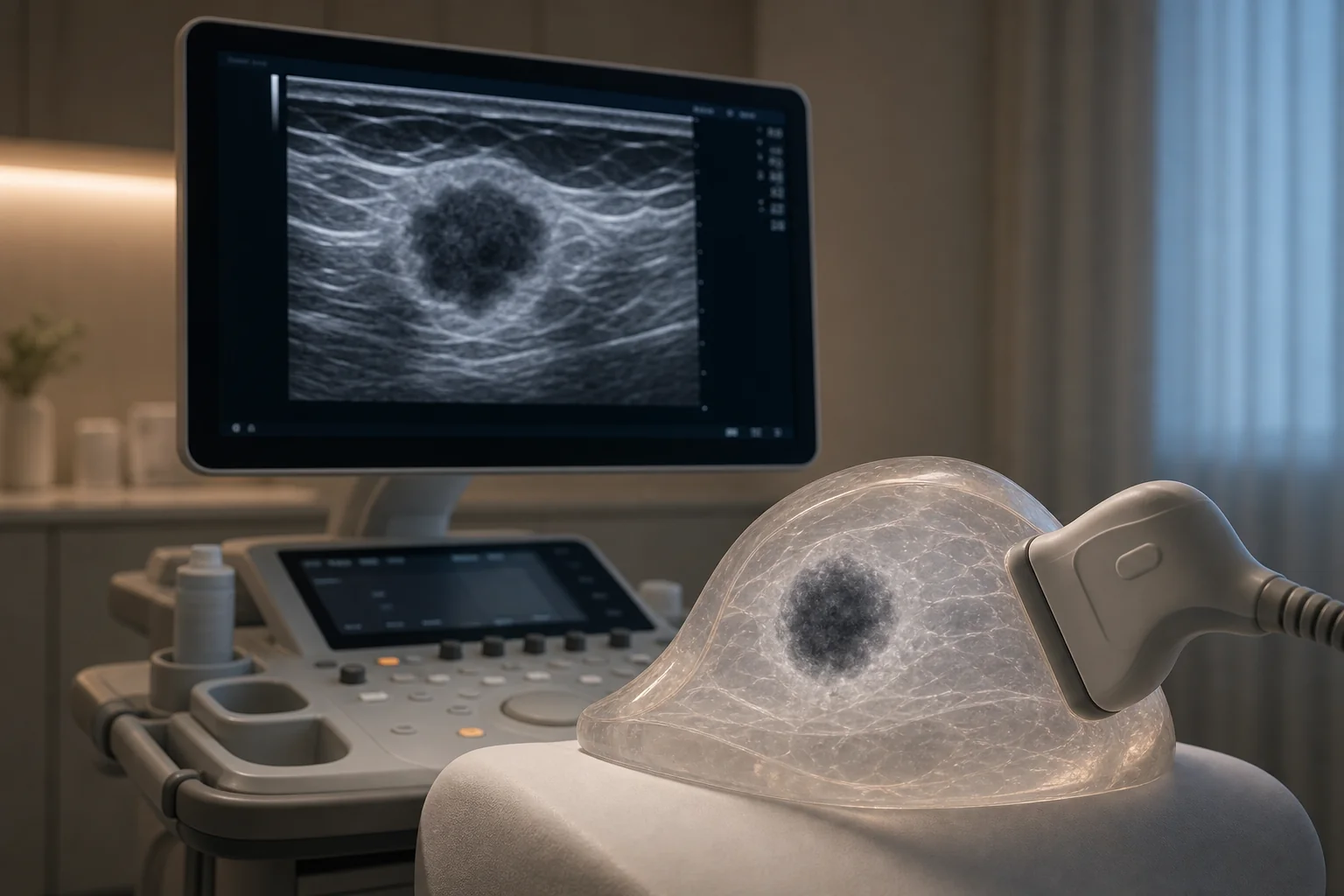
- Cross-stage attention sharpens useful tumor cues and trims noise
- Three expert branches read the whole tumor, core, and boundary
- The model reached 99.50% AUC on 2,129 balanced images
- It also improved accuracy, recall, and F1 over ResNet-18
When an ultrasound image is fuzzy at the edges, even a trained eye can struggle to tell benign from malignant. This paper tackles that problem with a new neural network (a software system inspired by connected brain cells) called CSA-MoE-Net. The model combines cross-stage attention, which highlights useful tumor features while downplaying noise, with a mixture-of-experts design that looks at the whole tumor, the tumor core, and the boundary separately before fusing them together. On a balanced set of 2,129 breast ultrasound images, averaged over 20 runs, it reached 96.33% accuracy, 94.09% precision, 98.53% recall, 96.25% F1-score, and 99.50% AUC. Compared with baseline ResNet-18, those scores improved by 3.01, 0.70, 5.37, 2.98, and 5.42 percentage points, respectively. The authors say the approach needs no invasive modification and can also be added to VGG-16 and DenseNet-121, making it a practical support tool for computer-aided diagnosis.
A 99.50% AUC sounds like a lab score, but it points to a real problem: breast ultrasound often shows tumors with blurred edges, uneven texture, and just enough noise to make a hard call harder. In that blur, a benign lump and a malignant one can look close enough to fool a single-pass model. CSA-MoE-Net tackles that by splitting the job instead of flattening it. On 2,129 balanced ultrasound images, averaged over 20 independent runs, it reached 96.33% accuracy and 98.53% recall, so it missed fewer cancers than the plain ResNet-18 baseline. The surprise is not that the network looks harder; it is that it looks in more than one way.
Three views of the same lesion
The headline result is simple: CSA-MoE-Net beats a baseline ResNet-18 across every reported score. Accuracy rose to 96.33%, precision to 94.09%, recall to 98.53%, F1-score to 96.25%, and AUC to 99.50%. Against ResNet-18, those gains were 3.01, 0.70, 5.37, 2.98, and 5.42 percentage points. The recall jump matters most when a missed cancer costs more than a false alarm, because it shows the model caught more malignant cases. The results were averaged over 20 independent runs, which makes the improvement feel less like a lucky spike and more like a steady gain. In a field where ultrasound images can be messy and data can tilt unevenly, that kind of consistency is the real prize.
How the model divides the work
CSA-MoE-Net starts with a Cross-Stage Attention-enhanced ResNet-18, which acts as the base model. Cross-Stage Attention keeps returning to the features at different depths, so useful tumor signals get boosted while redundant detail gets pushed down. On top of that, the Mixture of Experts block gives three branches separate jobs: one reads the whole tumor image, one studies the tumor core, and one watches the boundary. Then an Adaptive Gating Network decides how much each branch should count before fusing them into the Fused Expert Feature. That matters because the model does not have to trust one view alone; it can pull context, texture, and shape into one decision.
on 2,129 balanced breast ultrasound images
baseline ResNet-18- The whole tumor image keeps the larger shape and surrounding context in view.
- The tumor core branch zooms in on the lesion's center, where direct clues live.
- The boundary branch watches the edge, where blur and shape can change the call.
“The Cross-Stage Attention module adaptively recalibrates multi-level features, thereby enhancing key tumor features and suppressing redundancy.”
“The surprise is not that the network looks harder; it is that it looks in more than one way.”
Why it matters for ultrasound reading
This design matters because breast ultrasound is already noninvasive, so the gain comes from smarter reading rather than a new procedure. The mechanism can be dropped into VGG-16, DenseNet-121, and similar networks, which makes it easier to fit into existing computer-aided diagnosis systems. That flexibility matters in clinic-like settings, where tools have to work with the software already in use, not ask for a whole new workflow. Just as important, the model's balanced performance is not only about one score; it improves precision, recall, and F1 together, so the system is not merely more cautious or more aggressive. It is more rounded.
What to test next
The next test is straightforward: drop CSA-MoE-Net into VGG-16 and DenseNet-121 without changing its core attention-and-gating design, then see whether the same lift holds. That matters because the mechanism already fits those backbones, and a gain that travels across architectures is stronger than a win on one model. If it holds, the useful lesson is not just that this set was easier to read. It is that breast ultrasound may reward a three-view habit of looking: whole image for context, core for detail, boundary for shape. Fuzzy scans stay fuzzy, but the model gets a better way to face them.
Comments