- The LHC could act like a giant atomic trap
- Laser light could unlock gamma beams far beyond today’s sources
- Those photons could feed electrons, positrons, muons, and more
- Existing CERN gear could bridge the gap to the next collider era
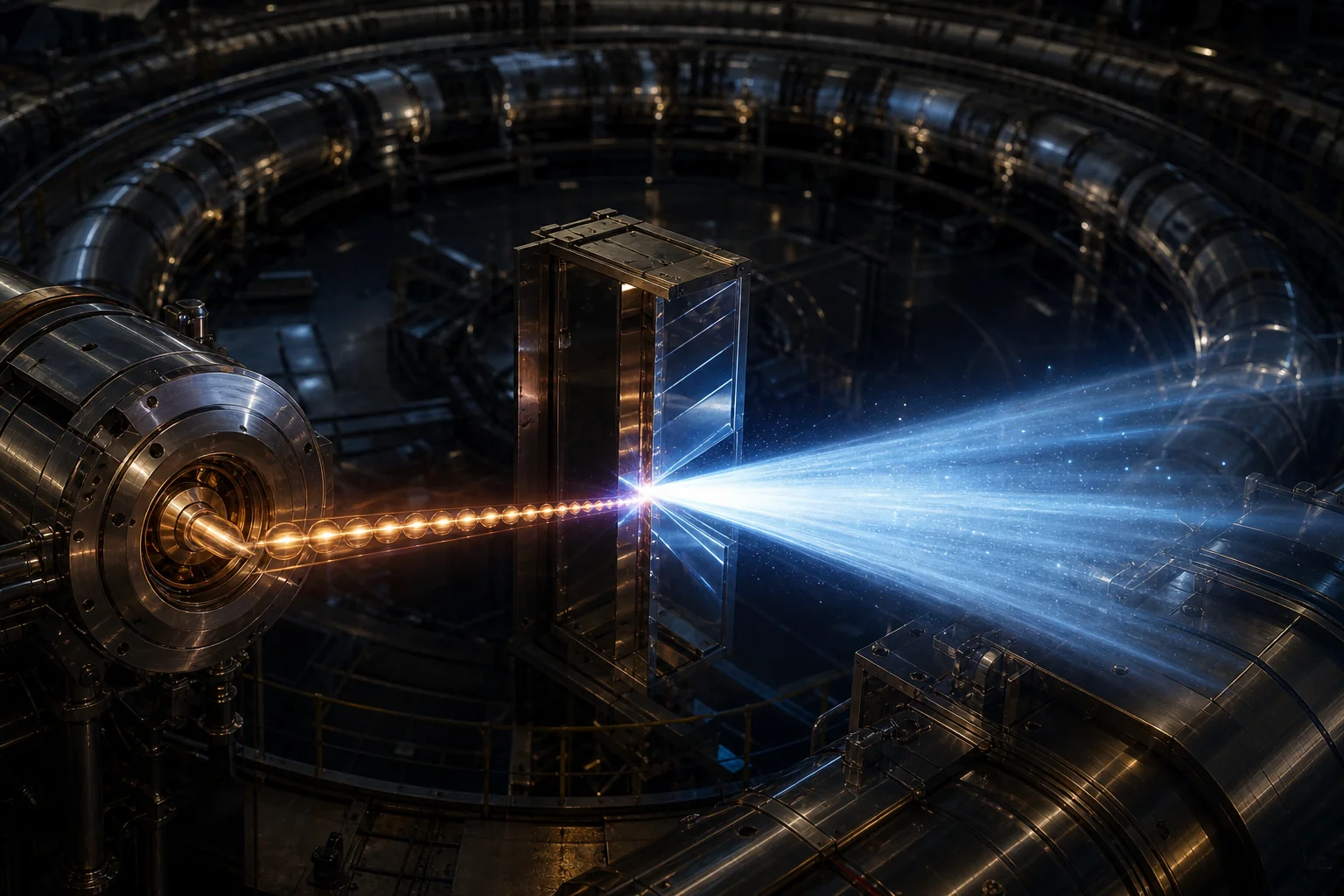
What if one of the world’s biggest particle colliders could also act like a giant atomic trap and beam factory? That is the idea behind CERN’s Gamma Factory proposal. It would store highly relativistic partially stripped ions in the LHC, then use laser photons to excite their internal states. In this scheme, laser light stored in Fabry–Perot cavities interacts with the circulating ions to produce high-energy, highly collimated, and polarised secondary gamma-ray beams. The paper says these beams could be far stronger than today’s gamma-ray sources, by several orders of magnitude. Those photons could then help generate tertiary beams of polarised electrons, positrons, muons, neutrons, radioactive ions, and flavour- or CP-tagged neutrinos. The authors argue that this could turn existing CERN infrastructure and state-of-the-art lasers into a cost-effective bridge between the HL-LHC era and the future FCC era.
The LHC is built to smash particles, not hold them still. Gamma Factory flips that idea. It would store partially stripped ions inside the collider. These are atoms that have lost some electrons, but not all. Then laser light would excite their inner states. That sounds strange. It matters because the same machine could then spit out gamma rays, the high-energy form of light. The abstract says those beams could be stronger than today’s gamma sources by several orders of magnitude. If that works, CERN would not just be a place for collisions. It would also become a giant light source. That is a very different role for the same tunnel. That is the surprise at the heart of the proposal. It takes the collider’s own speed and turns it into light.
When the collider acts like an atomic trap
The proposal is bigger than one beam trick. The LHC could serve as an effective atomic trap. It could also help as a source of low-emittance beams. That means beams with little spread. In the same scheme, laser pulses stored in Fabry-Perot cavities would meet the circulating ions again and again. Those cavities are mirror setups that bounce light many times. That lets each pulse do more work. The result would be secondary gamma beams that are highly collimated. That means they stay narrow. They would also be polarised. That means their light waves share the same direction. The abstract says their intensity could beat current gamma sources by several orders of magnitude. Those gamma beams could then drive more beams. The list includes electrons, positrons, muons, neutrons, radioactive ions, and neutrinos. The neutrinos can carry flavour or CP tags, a matter-antimatter label.
How laser light gets turned up
Start with atomic beams of highly relativistic partially stripped ions. That means atoms racing near light speed with some electrons still attached. Cool them, then store them in the LHC. At that point, the collider acts less like a smash room and more like a trap. The ions keep their inner structure. Lasers can then hit those internal states at the right energy. The stored laser pulse and the moving ion beam meet inside the machine. Each pass can lift the light into a gamma beam. The same setup can also serve as a high-precision probe. It can even supply low-emittance beams for ion-ion running.
than existing gamma-ray sources
today's gamma-ray sources- Gamma beams could feed polarised electrons and positrons.
- They could also make muons and neutrons.
- They could produce radioactive ions and neutrinos with flavour or CP tags.
- One setup could even help cover the plug power for LHC operation.
“Their expected intensities exceed those of existing gamma-ray sources by several orders of magnitude.”
“a versatile experimental platform”
Why CERN wants this bridge now
That bridge matters because CERN already has the big machine. It also has state-of-the-art laser tools. The proposal tries to use both. The abstract calls the path cost-effective and timely. That is the practical bet. Instead of waiting for a new giant collider, Gamma Factory could keep experiments moving. It would cover the shift from the high-luminosity LHC, the upgrade that raises collision rates. It would also help bridge to the future FCC era, the next planned collider phase. It could widen the menu of beams available to physicists. It could also link particle, nuclear, atomic, fundamental, and applied physics in one place. In plain terms, one tunnel could support many kinds of experiments, not just one kind of collision.
The test that decides the idea
The surprise still matters most here. A collider built for smashing matter could also become a source of light. If the stored ions behave as planned, CERN would gain a new kind of machine without building a brand-new tunnel first. That would help bridge the gap between the current LHC era and the future FCC era. The next real test is simple to state. Can partially stripped ions stay useful inside the LHC? Can lasers keep driving them the way the scheme needs? If yes, Gamma Factory stops sounding like a side idea. It becomes a new role for an old giant.
Comments