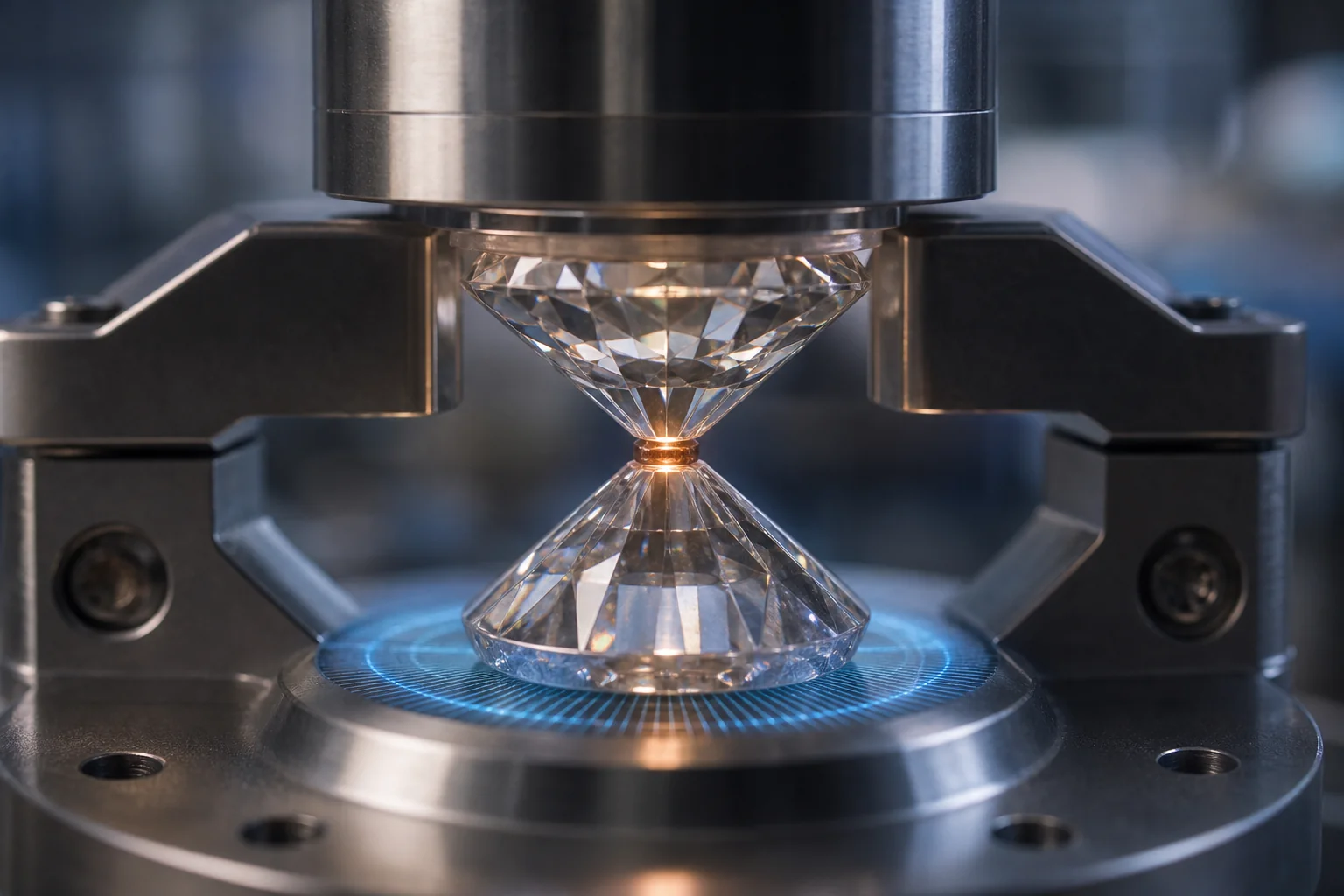
- NV sensors on the anvil face
- Iron's magnetic field through 30 GPa
- The α-ε transition in iron
- Magnetic probes inside diamond anvil cells
When a material is squeezed to the extreme pressures inside a diamond anvil cell, even its magnetism can change. Iron is the test case here. The team used an ensemble of nitrogen-vacancy (NV) centers—tiny defects in diamond that act as magnetic sensors—fabricated directly on the anvil surface to image iron’s stray magnetic field under pressure. That setup let them make precise magnetic measurements up to 30 GPa, a range where magnetometry has been hard to do. With those measurements, they observed iron’s α-ε transition, the magnetic change between two pressure-driven phases of the metal. The result shows that diamond quantum sensors can measure magnetic behavior in the same tiny, high-pressure space where the sample is being squeezed. That matters because diamond anvil cells can reach ultrahigh pressures, but the sample chamber is very small, so conventional probes struggle to fit and still work reliably.
Thirty gigapascals can change iron's magnetic state. It can also hide that change inside a diamond anvil cell. The surprise is that a diamond flaw still reads the field there. The flaw is an NV center, or nitrogen-vacancy center. That is a tiny defect in diamond that senses magnetism. The cell squeezes the sample between two diamond tips. The sensing layer sits on one of those tips. So the probe stays with the squeeze. That matters when the place you need to measure is also the place with almost no room. Pressure already drove H3S to 203 K at 155 GPa. It pushed LaH10 to 250 K at 170 GPa. Extreme pressure does not just compress matter. It can rewrite its state.
Reading iron inside the anvil
The setup imaged iron's stray magnetic field up to 30 GPa. That field is the small leak that escapes a magnetized material. As pressure rose, the signal showed iron's α-ε transition. That is the switch between two pressure phases of iron. Diamond quantum sensors offer high precision and spatial resolution. That makes them strong magnetic probes. Here, those strengths worked under high pressure. The result gives a direct look at iron while it is being crushed. It also shows that magnetism can be read inside the same tiny space where pressure is made.
iron's stray field stayed visible
inside the diamond anvil cell- Pressure can force a structural phase transition.
- Pressure can trigger a superconducting transition.
- Pressure can drive a quantum phase transition.
“By fabricating an ensemble of NV centers directly on the anvil diamond surface, we enable precise magnetic measurements under high pressure.”
How the diamond defect works
NV centers are tiny defects in diamond. A nitrogen atom sits beside a missing carbon atom. That flaw can sense magnetic fields. An ensemble is a crowd of those defects working together. The crowd was built right on the anvil diamond surface. That surface sits next to the sample chamber. The chamber is the tiny space between the diamond tips. So the sensor and the sample stay close. That closeness matters when the field from iron is faint. It lets the sensor image the stray field under pressure. The method uses diamond as both press and probe. That is the trick that makes the measurement possible.
Why this matters for pressure studies
Diamond anvil cells can reach 400 GPa. They can still leave almost no room for a sensor. That size problem has limited magnetic measurements. This work changes the layout. The sensor lives on the anvil face itself. It reads the field where the squeeze happens. That makes high-pressure magnetism less of a blind spot. It also points to a wider use for diamond quantum sensors. The abstract calls them promising for a wide range of applications. That promise matters beyond iron. A closer probe fits many pressure-driven changes better.
What comes next
The surprise here is not that pressure changes iron. The surprise is that the probe can live on the anvil and still see it. The next useful test is the same NV layer at even higher squeeze. Thirty GPa proved the idea in iron. Higher pressure will show how far the trick scales. If it holds, magnetism inside a diamond anvil cell stops being a hidden act. It becomes something you can watch as it happens. That would make the pressure cell less of a black box for magnetic change. It would also give a cleaner read on phase shifts.
Comments