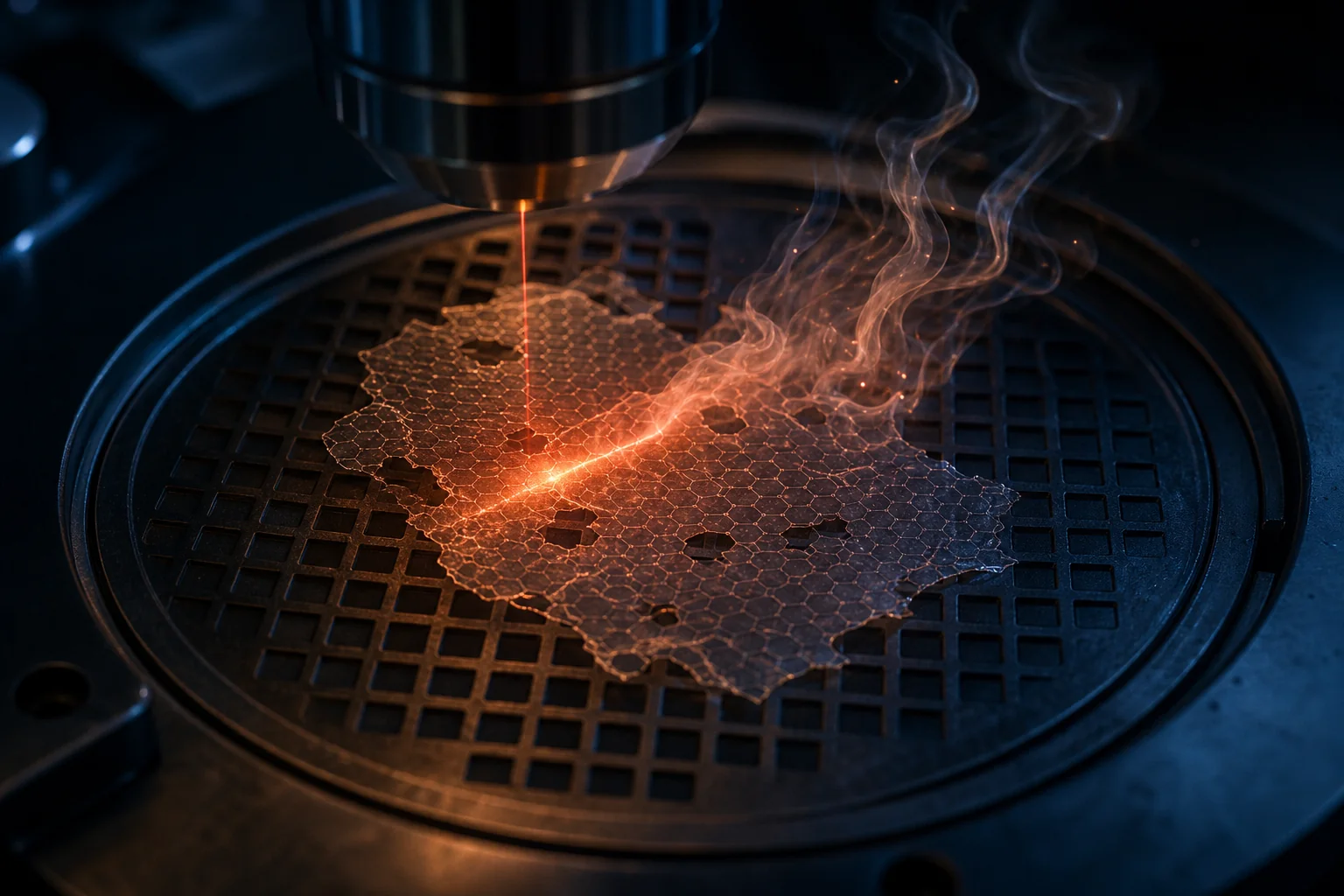
- Electron-beam priming makes infrared reduction much faster
- 90% of a 46-nm film changed in 960 ns
- Oxygen moved with diffusivity of 1.6 ± 0.4 × 10^-8 m2/s
- The beam changed how strongly GO absorbs near-infrared light
A material only a few dozen nanometres thick can change dramatically in less time than a blink. In this paper, graphene oxide was reduced by a single near-infrared laser pulse, but only after electron-beam irradiation had primed it first. Using a dynamic transmission electron microscope and time-resolved electron energy-loss spectroscopy, the team tracked oxygen leaving the film in real time and measured an oxygen diffusivity of 1.6 ± 0.4 × 10^-8 m2/s. That rate corresponds to 90% reduction of a 46-nm-thick film within 960 ns. The electron beam also changed how strongly graphene oxide absorbed near-infrared light, and simulations reproduced the heating cycle caused by the laser pulse. Electron microscopy and diffraction then showed local restoration of sp2 bonding, along with turbostatic disorder in the reduced material. The results point to a simple but powerful mechanism: electron-beam-created defects and vacancies make the material absorb the infrared pulse more efficiently and let oxygen move out normal to the layers faster.
A 46-nanometre film can change faster than a blink. In this case, 90% of its oxygen leaves in 960 nanoseconds. That is less than a millionth of a second. The film is graphene oxide, a carbon sheet packed with oxygen groups that change how it behaves. The surprise is not just speed. A prior electron beam makes the next infrared laser pulse work far better. If you have ever watched heat race through a thin metal foil, this is that feeling, but on a sheet made of atoms. The beam does one quiet job first. It changes the material before the light hits it.
A primed film reacts like a lit fuse
The main result is simple to state and wild to picture. Near-infrared light, or NIR light, means light just beyond red. One single pulse reduced graphene oxide after the film had been hit by an electron beam. A dynamic transmission electron microscope, or DTEM, watched the change in real time. Time-resolved electron energy-loss spectroscopy, a way to track which atoms are present by the energy electrons lose, showed oxygen falling away after the pulse. From that trace, the oxygen diffusivity came out to 1.6 ± 0.4 × 10^-8 m2/s. That speed lines up with 90% reduction of a 46-nm film within 960 ns. In plain terms, oxygen did not just leave. It rushed out through a very thin stack of layers.
Why the electron beam matters
The trick starts before the laser fires. Electron beam irradiation changes the film in two linked ways. It creates defects and vacancies, which are tiny missing spots in the carbon sheet. It also changes how much NIR light the film absorbs. The paper then simulates the thermal heating cycle from the laser pulse. That matters because the pulse only does useful work if the film takes in the light. After the pulse, selected-area electron diffraction, or SAED, and high-resolution transmission electron microscopy, or HRTEM, show local return of sp2 bonding. That means some carbon atoms rebuild the bonded pattern found in better-ordered graphene-like regions. The same images also show turbostatic disorder, a twisted and misaligned layer pattern.
of a 46-nm film in 960 ns
after electron-beam priming- The beam makes the film absorb near-infrared light more strongly.
- The pulse then drives oxygen out of the layers faster.
- The structure partly recovers sp2 bonding and also keeps turbostatic disorder.
“Rapid and controllable reduction of graphene oxide (GO) remains a critical challenge for realizing its full technological potential.”
“the creation of defects and vacancies produced by electron beam irradiation”
What changes when defects do the work
This result matters because graphene oxide is useful only when its chemistry can be tuned with care. Too little change leaves it oxygen-rich and less graphene-like. Too much heat or too slow a process can make control hard. The beam-plus-pulse route gives a sharper handle. It shows that defects are not just damage. They can act like a switch that helps the material drink in infrared light and move oxygen out of plane, normal to the layers. That opens a path to faster photochemistry in thin carbon films. It also gives a concrete reason why pre-treatment matters. The same light pulse can do very different things depending on the film state before it arrives.
The next test is the film, not the slogan
The clean next question is how far this behavior holds across other graphene oxide films and other beam doses. This study ties the speed to a 46-nm film and to electron-beam priming. That makes film thickness and pre-history central, not decorative. The open test is whether the same fast drop in oxygen shows up when the layer stack, defect level, or beam exposure changes. If it does, near-infrared reduction could become a more precise tool for making reduced graphene oxide with tuned order and disorder. If it does not, the method will still have taught a useful lesson: in graphene oxide, the prelude can matter as much as the flash.
Comments