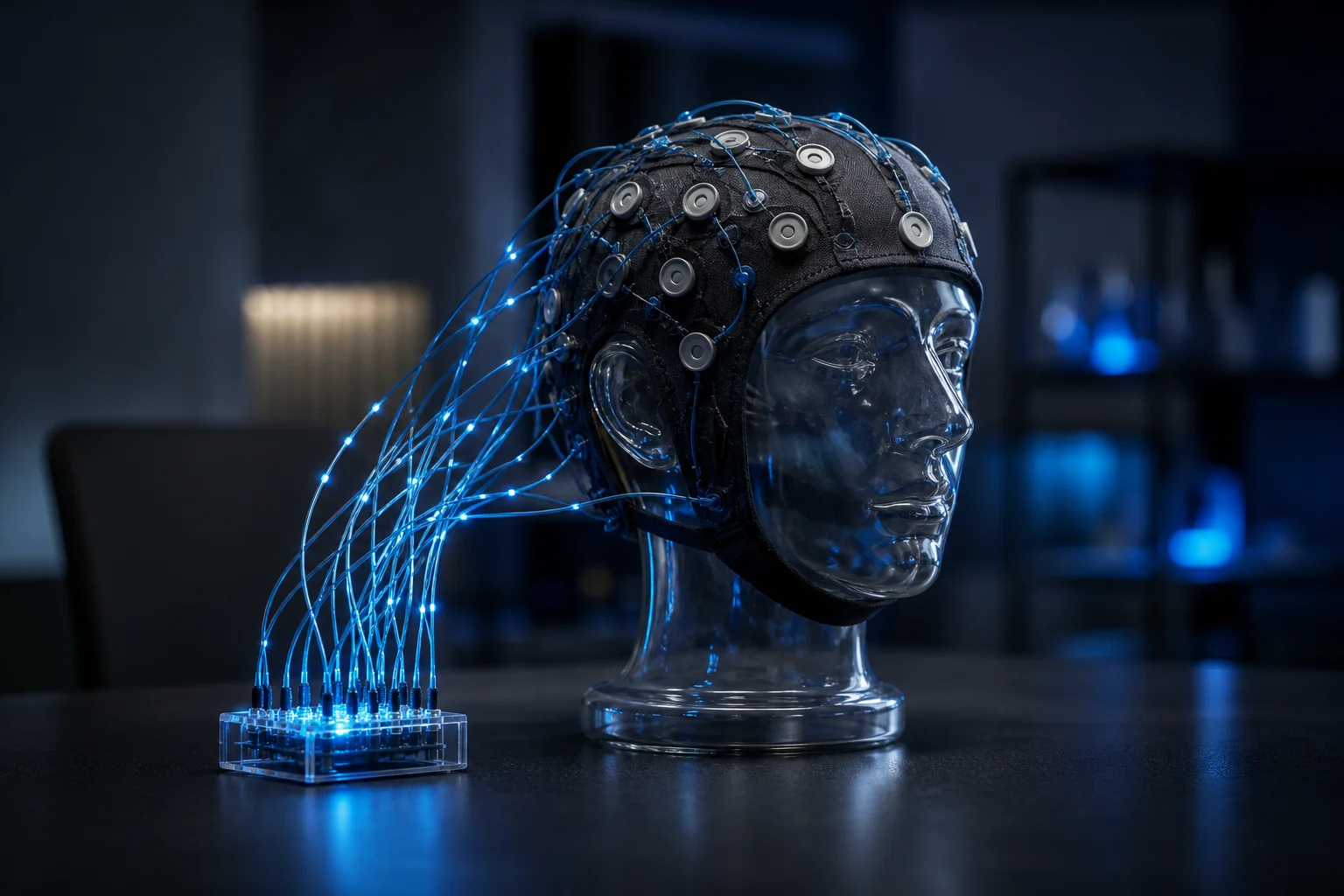
- Privacy-preserving cross-subject EEG decoding
- Foundation model plus specialist model partnership
- Cross-branch label cleanup and refinement
- State-of-the-art results on three EEG paradigms
If a brain-computer interface has to learn from your EEG, it usually struggles when it meets a new person. This paper tackles that problem without touching the original training data, which matters when privacy and practical deployment both matter. The authors introduce FUSED, a framework that pairs a large EEG foundation model — a model pretrained on large-scale data — with a compact specialist model for source-free domain adaptation, meaning the system adapts to an unlabeled target user without access to source data. FUSED uses two branches with linear and prototype views to generate pseudo-labels, then filters samples by consensus, refines labels in two stages, and calibrates the foundation model before distilling its knowledge into the specialist model. Across three EEG paradigms — motor imagery, emotion recognition, and SSVEP — the framework delivers consistent state-of-the-art performance. The result is a more robust route to cross-subject EEG decoding that keeps source data out of the loop.
A headset trained on one person often stumbles on the next one. That is the daily pain of cross-subject EEG decoding, where one model must work on a new person's signals. EEG means electroencephalography, the non-invasive reading of brain signals from the scalp. FUSED takes a stranger route. It pairs a large EEG foundation model, a model trained on lots of EEG, with a compact specialist model. Then it lets the two models judge each other's guesses on unlabeled target data. Those are new signals without human tags. Source-free domain adaptation means adapting to a new person without the old training data. That keeps source data out of the loop. It also matters when a new brain looks just different enough to confuse a normal decoder.
Why a smaller model still needs a big teacher
Across motor imagery, emotion recognition, and SSVEP, FUSED kept winning. SSVEP means steady-state visual evoked potential. That is the brain's response to a flickering visual cue. The framework reached state-of-the-art performance. That means it beat the other tested methods in all three EEG settings. That is the central result. The large model did not replace the small one. The two models helped each other instead. The foundation model brought broad knowledge. The specialist model stayed lean and task-focused. Together, they made cleaner pseudo-labels. Pseudo-labels are guessed labels used when real labels do not exist. That cut the noise that usually derails source-free adaptation.
motor imagery, emotion recognition, and SSVEP
How FUSED keeps noisy guesses in check
FUSED gives both branches two ways to read a signal. One is a linear view, which is a direct classifier. The other is a prototype view, which compares a sample with class summaries. Each branch then makes pseudo-labels for the other branch. A consensus filter keeps the cleaner samples. A two-stage refinement step then lets the branches arbitrate before bad guesses spread. After that, FUSED tunes the foundation model with mutual information maximization. That is a way to keep its output in step with the specialist model. It then distills that knowledge into the smaller model. Knowledge distillation means a bigger model teaches a smaller one.
- The linear view gives each branch a direct guess about the class.
- The prototype view compares each sample with class summaries.
- Consensus filtering keeps the steadier samples and drops noisy ones.
- Two-stage refinement and distillation push the cleaner signal into the small model.
“To our knowledge, FUSED is the first work to leverage EEG FMs within the SFDA framework for cross-subject EEG decoding.”
Why this setup matters for privacy
The surprise is not just that the big model helps. It helps without seeing the source data. That makes FUSED practical for EEG, where data can be hard to share and hard to label. The framework also fights a common trap. In source-free settings, bad pseudo-labels can snowball. FUSED cuts that risk by trusting the foundation model when it looks steady. It also checks labels across both branches. The result is a cleaner path from one person's brain to the next. That suits brain-computer interfaces that must adapt fast and still respect privacy.
What source-free decoding now looks like
Bigger does not mean clumsier here. It means steadier. FUSED shows that a large EEG model can guide a smaller one without source data. That opens a more private route for cross-subject decoding. A system could adapt to a new user while old EEG records stay put. That is the concrete promise here. That is the surprise worth keeping. If this pattern holds, source-free EEG tools become easier to deploy in real settings. They also stay easier to share across labs and devices.
Comments