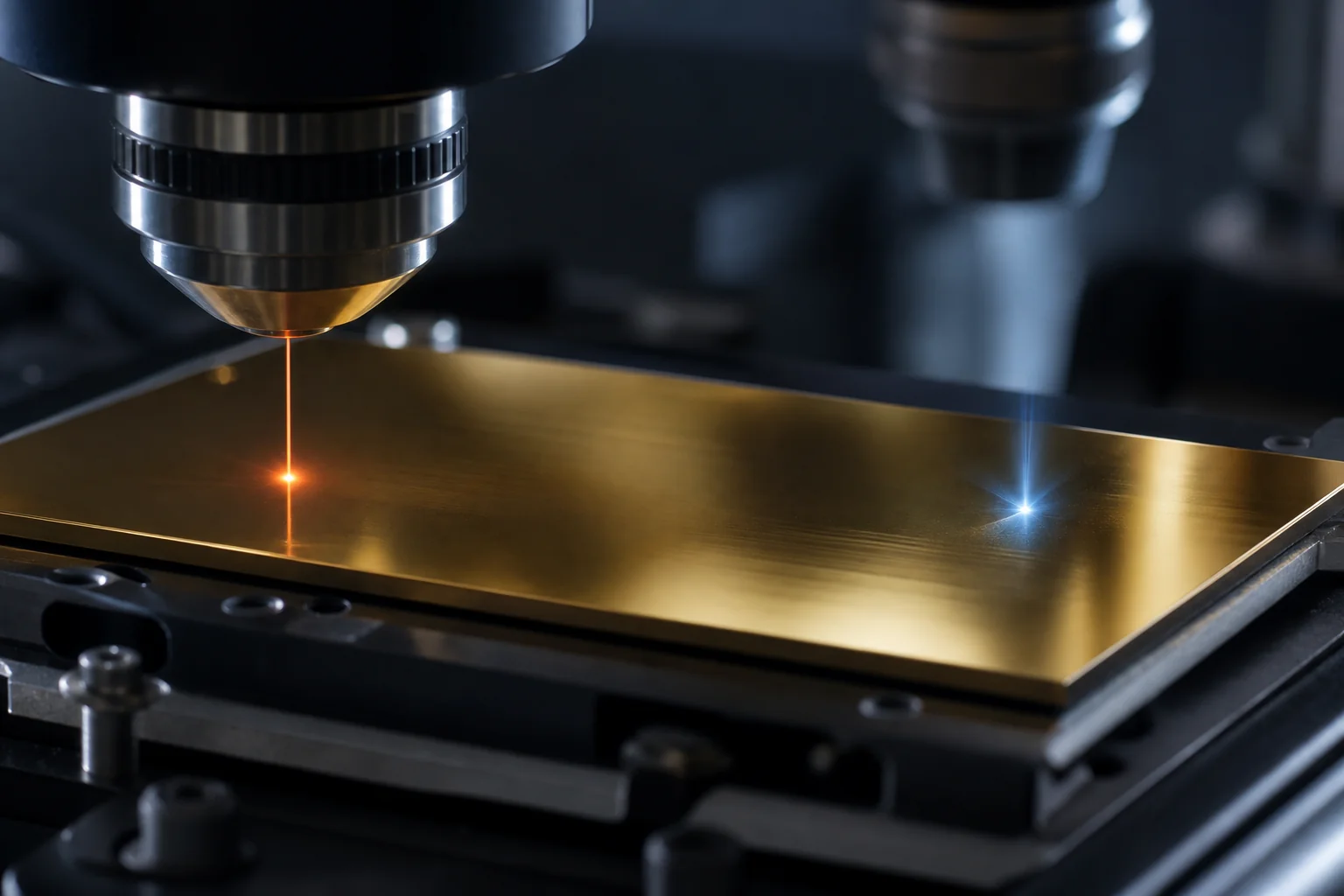
- Delocalized second-harmonic light on gold
- 35 µm reach from one excitation spot
- Two surface waves running opposite ways
- One beam for buried-interface sensing
A single laser spot may now reveal signals from regions tens of micrometers away, instead of only the exact place it hits. That matters for layered materials, where the signal from one interface can be buried under others. The paper reports direct observation of delocalized second-harmonic generation, a nonlinear optical process that turns two photons at one color into one photon at twice the frequency. On monocrystalline gold surfaces and structures, the team generated second-harmonic light up to 35 µm from the excitation spot, and even detected signal from atomically flat surfaces where no fundamental excitation beam was present in the same region. The authors trace the effect to two counter-propagating surface plasmon polaritons interacting with each other, a process they say has not been seen at this scale before. The emitted light kept the same polarization dependence as localized second-harmonic generation and came out as a collimated beam perpendicular to the sample surface. Because the signal was strong enough, the team captured it on a CMOS camera with 1 s exposure, no gain, and an industrial-grade pulsed laser. They say this could help probe wide-area multilayer samples with one excitation beam for energy, catalysis, and single-particle surface sensing.
35 micrometers is far enough to cross many cell bodies. It is also far enough to miss the laser spot. Yet a gold surface still sent second-harmonic light from that distance. Second-harmonic generation means two light packets at one color join into one packet at twice the color. That makes it a neat probe for crystal shape and electric fields at interfaces. The surprise is the reach. The glow did not stay tied to the hit point. It leaked out across the surface and showed up where no beam landed. That opens a new way to read hidden layers in stacked materials.
A signal that escapes the beam
The gold did more than glow near the beam. It sent second-harmonic light up to 35 microns away. The map also showed signal from atomically flat spots with no laser beam there. That points to light travel on the metal before the glow appears. The signal is delocalized, so it is not locked to one tiny spot. The effect comes from two surface plasmon polaritons, surface light waves that run in opposite directions along gold. When those waves meet, they can feed the second-harmonic glow. The result may be the first small-scale view of that two-wave meeting. The signal kept the same polarization pattern, or light wiggle direction, as local second-harmonic generation. It also left the surface in a tight beam that shot straight up. That beam shape makes the signal easier to spot. The same effect showed up on atomically flat surfaces with no beam there.
How the light gets around
The setup used one pulsed laser beam on gold. The beam launched surface plasmon polaritons, or surface light waves that hug a metal. Those waves spread along single-crystal gold surfaces and structures. The metal helped trap and steer the energy. Strong local electric fields built up near the surface. That boost made the second-harmonic light bright enough for a CMOS camera. A CMOS camera is the kind used in many industrial sensors. The camera saw the signal with one second of exposure and no gain. No gain means the sensor did not need extra electronic help. An industrial-grade pulsed laser was enough for the test. That is a practical clue for wider use.
second-harmonic light reached that far
single laser hit- Energy studies can probe wide-area multilayer samples with one beam.
- Catalysis work can read buried interfaces in layered stacks.
- Single-particle surface sensing can use the same far-field glow.
“we obtain signal from atomically flat surfaces without a fundamental excitation beam present in the same region.”
Why buried layers care
This reach matters most in layered materials. One beam can now pull a useful signal from places it never touches. That helps when one layer hides another. It also helps when different materials compete for the same light. The collimated beam is important too. It rises straight out of the surface, so it is easier to catch on a camera. The work points to wide-area probes for energy, catalysis, and single-particle surface sensing. It turns a tiny spot into a messenger for a much larger patch. It also reduces the need for many separate hits. That can simplify a scan across a wide surface.
The next test for one beam
The next test is a wide-area multilayer sample. That is where buried interfaces can hide in plain sight. The surprise here is not just brightness. It is that light can answer from outside the beam. If that holds in harder stacks, one excitation beam could map more than one layer at once. That would make buried-interface spectroscopy much simpler to run. It would also fit the claim that the glow can come from atomically flat gold with no beam in place. The real challenge now is keeping that far-away signal clean when several layers speak at once. That is the kind of test that will show how far the idea reaches.
Comments