- CPA-PA scores models against a ground-truth approximation
- It uses alignment and participant averaging
- It beat standard scores by 300–1000% on synthetic EEG
- It beat them by 250% on 34 real MEEG datasets
When a model predicts brain activity, the hard part is judging whether it is truly right or just matching noise. That problem matters because the signal scientists want is buried inside noisy electro- and magneto-encephalography, or MEEG, measurements. This paper tackles that by comparing model predictions to a ground-truth approximation, built with canonical correlation analysis, a way to align two data streams, and with participant averaging. The new score, called CPA-PA, improved single-participant evaluations by about 300–1000% on synthetic EEG data and by about 250% on 34 real MEEG datasets, covering 818 datapoints. The gains came from better sensitivity to stimulus-relevant neural activity and less dependence on signal-to-noise ratio. In plain terms, the paper offers a sturdier way to tell whether an encoding model is capturing the brain’s response to a stimulus, instead of being fooled by measurement noise.
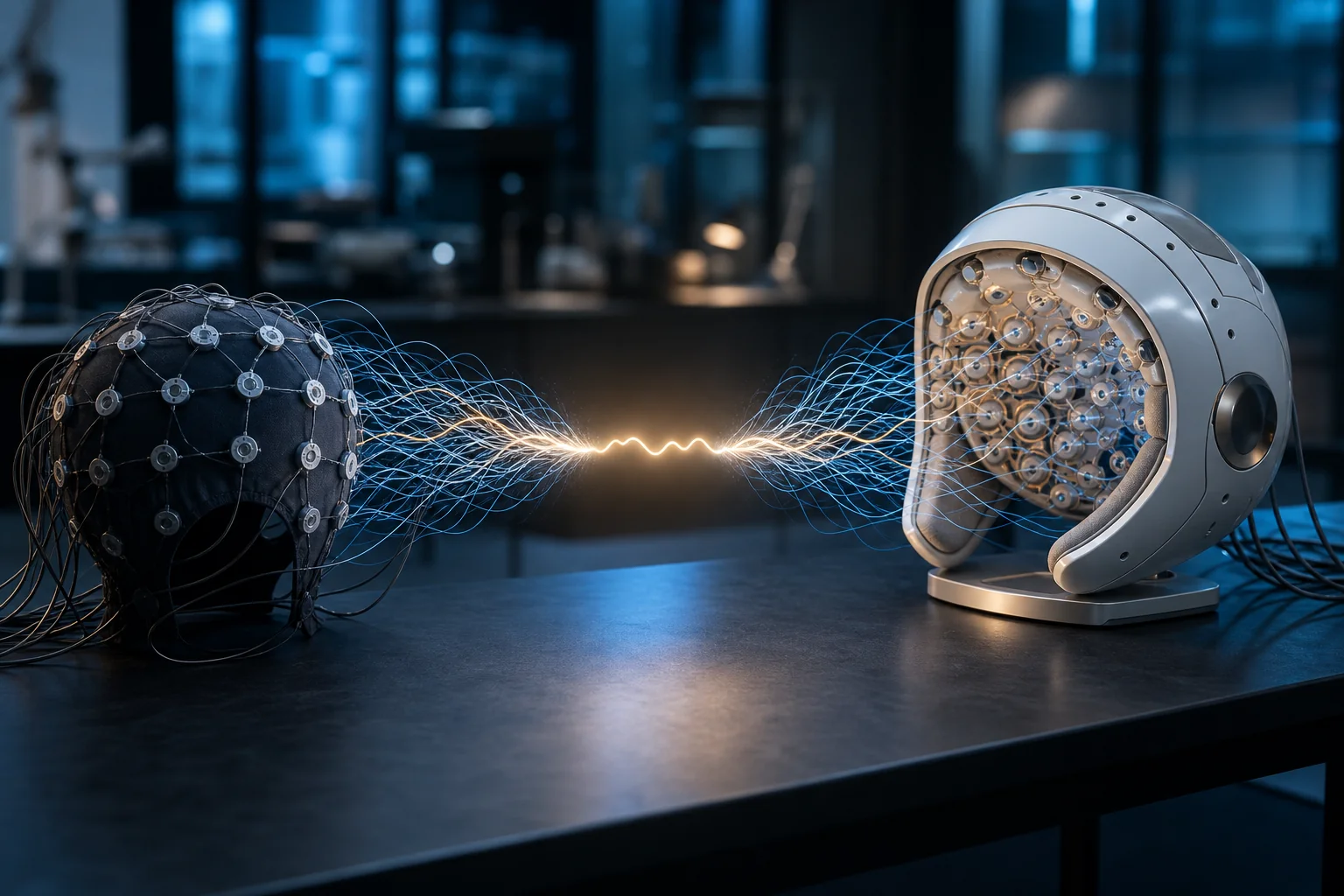
A brain model can look impressive and still miss the real signal. That is the trap in MEEG, short for electro- and magneto-encephalography. These sensors pick up tiny electrical and magnetic traces from the head. They also pick up a lot of noise. So a score can rise for the wrong reason. This study tackles that problem head-on. It asks a sharp question: what if we judged the model against a cleaner stand-in for the brain signal, not the raw noisy trace? That shift turns evaluation into a test of the signal people actually care about.
When a good score can still be misleading
The new score is called CPA-PA. It compares model predictions to a ground-truth approximation. That approximation comes from two steps. First, canonical correlation analysis, a way to line up two streams of data, matches MEEG signals with the model's predictions. Second, participant averaging blends data across people to reduce random noise. The result is a fairer yardstick for single-person tests. On synthetic EEG data, CPA-PA improved single-participant scores by about 300 to 1000 percent. On 34 real MEEG datasets, with 818 datapoints, it improved them by about 250 percent. Those gains point to one thing. The score tracks stimulus-relevant neural activity better than standard metrics do.
How the new test builds a cleaner target
Canonical correlation analysis sounds heavy, but the idea is simple. It looks for shared shape between two data sets. Here, it helps the brain signal and the model's prediction meet in the middle. Participant averaging then softens the random bumps that differ from one person to the next. Together, they form a proxy, or stand-in, for the hidden neural target. CPA-PA then scores the model against that proxy. This matters because the raw MEEG signal is not pure brain truth. Much of its spread comes from stimulus-unrelated variance. The new framework tries to measure what the stimulus really drove.
on synthetic EEG with CPA-PA
conventional scores- CPA-PA aligns model predictions with MEEG using canonical correlation analysis.
- Participant averaging then builds a cleaner ground-truth approximation.
- The final score compares the prediction to that approximation instead of raw noise-heavy data.
“The resulting metric (CPA-PA) yields single-participant evaluations outperforming conventional scores by ~300-1000% on synthetic EEG data and ~250% on 34 real MEEG datasets (818 datapoints).”
“increased sensitivity to stimulus-relevant neural activity”
Why this changes model evaluation
The practical gain is simple. Better scoring means better judgment. If a model is meant to explain how the brain tracks sound or sight, a noisy benchmark can hide real progress or fake it. CPA-PA pushes evaluation toward the target signal itself. That makes model comparison less tied to signal-to-noise ratio, or SNR, which is the balance between useful signal and random noise. The paper says the new framework shows increased sensitivity to stimulus-relevant neural activity and reduced dependence on SNR. In plain terms, the score cares more about the brain's response to the stimulus and less about how messy the recording happens to be.
The next test for this idea
The clearest next test is whether CPA-PA keeps its edge across more MEEG settings and more kinds of stimulus. The paper already reports gains on synthetic EEG data and on 34 real MEEG datasets with 818 datapoints. That is a strong start. The open question is whether the same ground-truth approximation still helps when recordings, people, or stimuli shift in harder ways. If it does, the field gets a sturdier way to tell whether an encoding model is learning the brain's response or only learning the noise around it. That is the surprise here. The best judge may not be the raw trace at all.
Comments