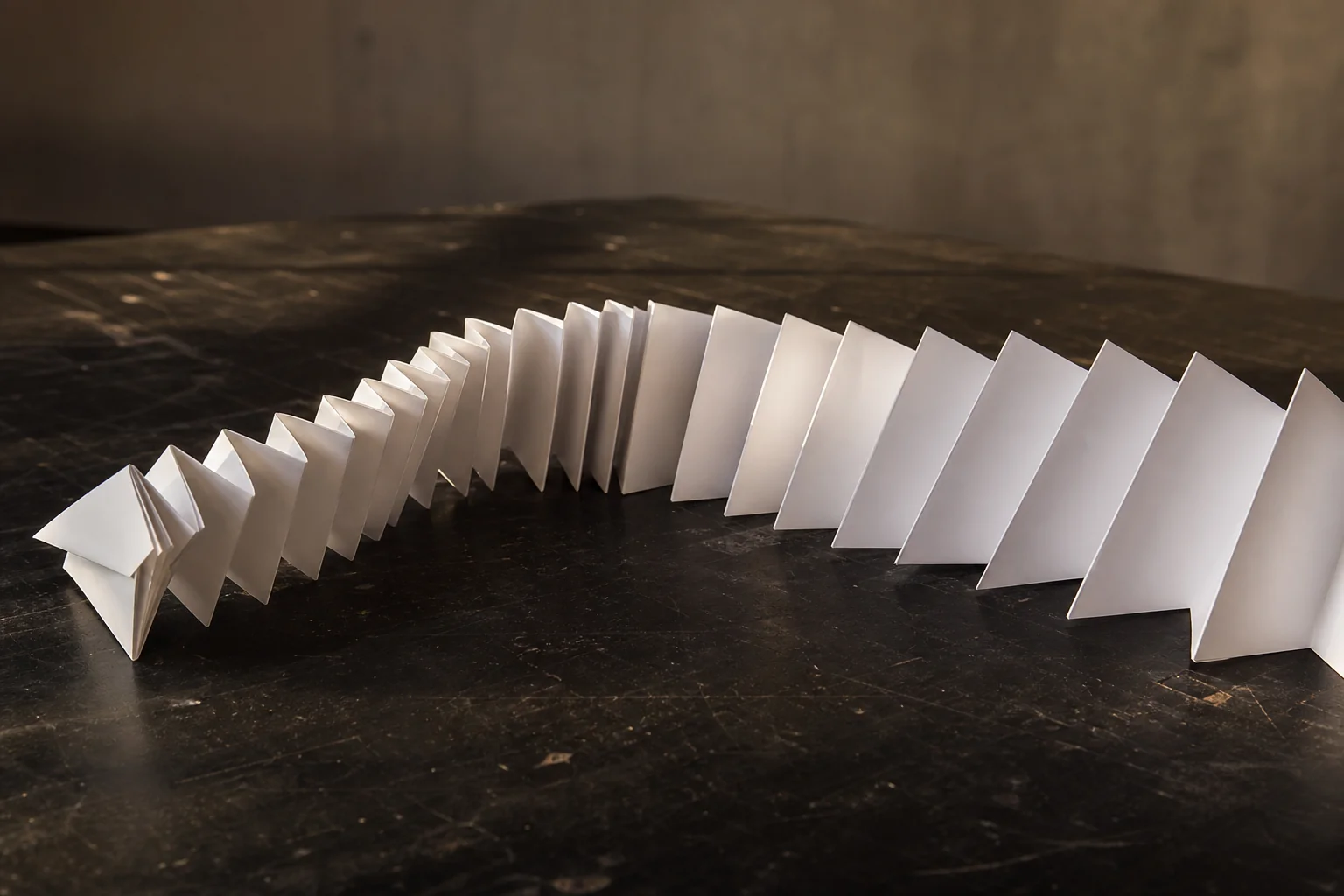
- Domino-like deployment fronts
- Geometry-only sequential motion
- Heteroclinic-orbit design rule
- Shape and motion tuned apart
- Thick-panel prototype
Imagine an origami structure that doesn’t unfold all at once, but wakes up one crease at a time like a row of falling dominoes. This paper shows how to program that kind of orderly motion using geometry alone, without relying on stored elastic energy. The authors build a design framework for kinematic transition fronts, linking them to heteroclinic orbits in discrete dynamical systems. Focusing on strips of developable, flat-foldable degree-4 origami vertices, they show that asymmetric coupling between neighboring creases creates nonlinear recurrence relations that can connect fully developed and fully flat-folded states. That connection produces sequential deployment along the strip. The paper also shows that the overall macroscopic shape can be chosen independently of how the motion propagates, using invariances in the recurrence relation. A thick-panel origami prototype illustrates the idea. The result is a general way to design domino-like deployment in origami, and a broader framework for kinematic transition fronts in geometrically constrained systems.
A strip of origami can unfold like a row of dominoes. One crease moves first. Then the next crease follows. The whole strip wakes up in a line. That order matters for deployable panels and compact tools. It also matters when a folded object must open without a violent snap. No stored spring energy has to do the work. Geometry can do it on its own. This study asks a simple question. Can shape alone force that chain reaction? The answer is yes. Even better, the final shape does not have to set the fold order. One design can control both.
Why one crease can pull the next
The key setup uses strips built from degree-4 vertices, where four creases meet at each fold point. Each vertex can be both developable and flat-foldable. Developable means the panel can bend without stretching. Flat-foldable means it can lie flat in the end. The strip works because adjacent creases do not act in the same way on both sides. That asymmetry creates a nonlinear recurrence relation, a step-by-step rule that links one fold angle to the next. When those rules are composed along the strip, they generically produce a heteroclinic orbit. That is a path that connects a developed state to a flat-folded state. In plain terms, one fold triggers the next. The result is a domino-like deployment front.
- Asymmetric coupling makes each crease feel the next one differently.
- The recurrence rule carries that difference along the strip.
- The orbit links flat-folded and developed states into one moving front.
How the front is programmed
A crease rule starts the design. That rule says how one crease angle depends on the next one. The rule comes from the vertex geometry. A different asymmetry gives a different front. The striking part is the invariance in that rule. An invariance is a feature that stays the same when other details shift. That lets the big folded shape stay fixed. The motion can still change. A thick-panel origami prototype puts the idea into a real build. It shows the script works in matter, not just in math.
“macroscopic shape can be programmed independently of propagation behavior”
Why shape and motion split
Two knobs now sit in one design. Shape and motion stop being the same problem. One part of the design sets the final folded form. Another part sets the order of unfolding. That matters for systems that need a calm, directed release. It also matters when a build must keep the same outer shape in different motions. The framework does not depend on stored elastic energy. It uses geometry and local links between creases. That makes the idea useful beyond one trick fold. It gives designers a way to think about deployment as a script, not a surprise.
What to test in other degree-4 strips
The thick-panel prototype shows the idea can leave the math page. The next test is broader than one strip. It is whether other strips of developable and flat-foldable degree-4 vertices obey the same script. If they do, a designer could tune the final form without changing the unfolding order. That would make a fold front more like a programmed route than a one-off snap. The surprise stays the same. Geometry can choreograph motion. It does not just hold a shape.
Comments