- Spin waves can now be chained into circuits
- Phase stays coherent for hundreds of wavelengths
- Coupled waveguides move power back and forth fully
- Programmable meshes reach six inputs and outputs
- No intermediate amplification is needed
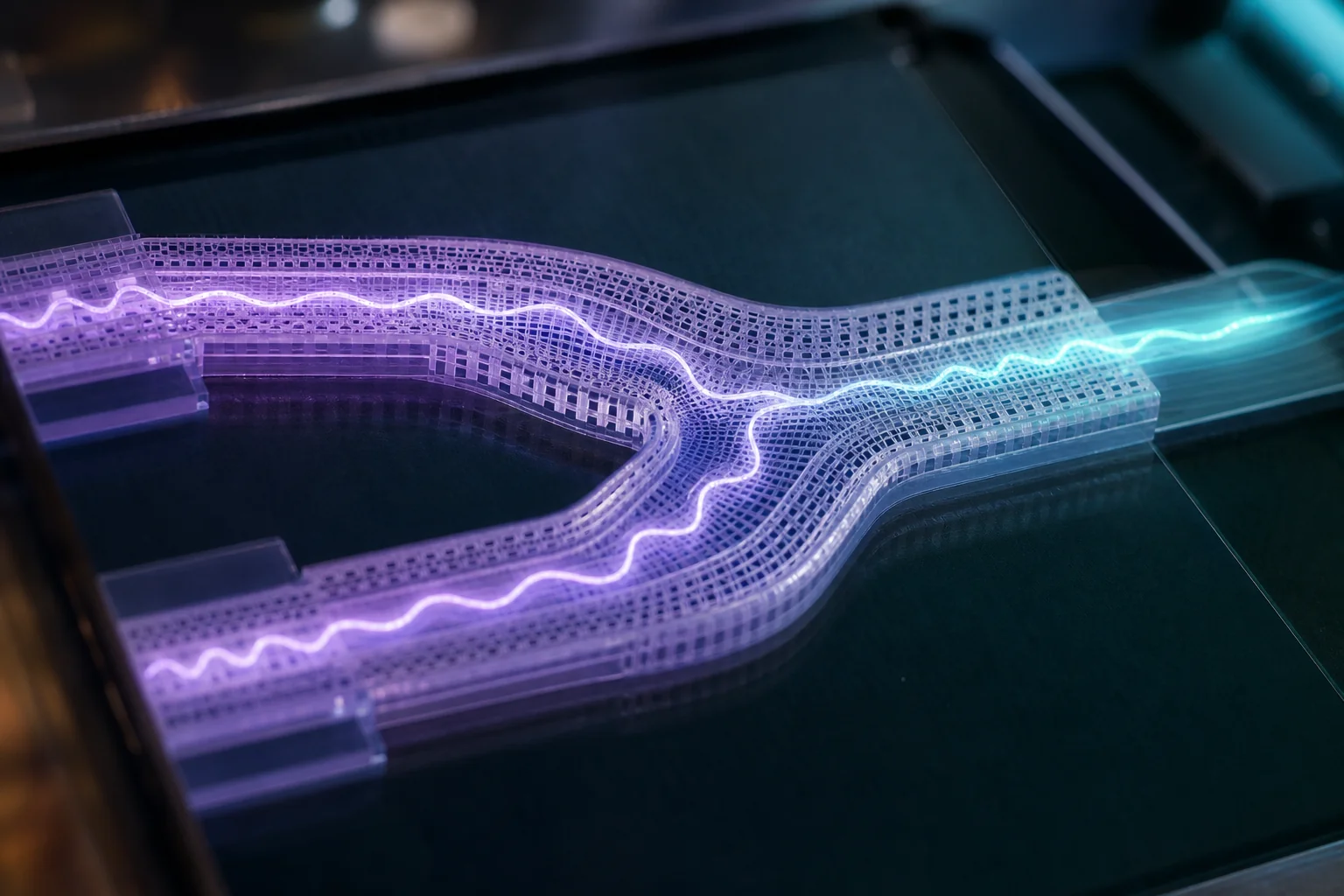
Imagine steering microwave signals inside a chip without converting them into electric charge. This paper shows that spin waves — tiny ripples of magnetization — can be chained into programmable circuits instead of staying as isolated parts. The team used a single-step direct laser writing process in yttrium iron garnet to build waveguides, coupled waveguides, and phase shifters on the same platform. With magneto-optical Kerr effect microscopy, they saw spin waves travel with preserved phase coherence for hundreds of wavelengths. In coupled waveguides, power moved back and forth completely and periodically over several coupling lengths, and the phase shifters produced arbitrary, tunable phase delays. By combining these building blocks, they made programmable splitters, frequency demultiplexers, and phase-controlled 2x2 routers, where output power and relative phase could be set on demand with external fields. They then extended this into interferometric meshes with up to six inputs and outputs and seven cascaded stages, without intermediate amplification. The result is a path toward larger magnonic circuits for classical and quantum processing.
A microwave signal can now take a turn inside a chip made from magnetic ripples. That is the surprise at the heart of this work. Spin waves are tiny waves of magnetization, not electric charge. They move through a magnetic material called yttrium iron garnet, or YIG, a crystal prized for low loss. The big leap is not just sending one wave down one path. It is chaining many wave parts into a working circuit. The result points to a new kind of on-chip signal router. It keeps the wave's phase, which is the timing of its crest and trough, under control across long paths.
From lone waveguides to working magnonic circuits
The paper shows four building blocks working together. First, waveguides carry spin waves with good phase coherence for hundreds of wavelengths. A waveguide is just a narrow path that guides a wave. Second, coupled waveguides let power move back and forth in a complete, repeatable way over several coupling lengths. Third, phase shifters give arbitrary, tunable delays. That means the wave can be nudged forward or held back on demand. Put those parts together, and the circuit can act as a splitter, a frequency demultiplexer, or a phase-controlled 2x2 router. The mesh form goes further. It reaches up to six magnonic inputs and outputs and seven cascaded stages, with no intermediate amplification.
How the chip was written and then tested
A single-step direct laser writing process built the YIG structures. That means a focused laser draws the needed shapes directly into the material. The platform stayed monolithic, so the parts were made on one chip rather than wired together later. The team then used magneto-optical Kerr effect microscopy, a light-based way to see how magnetization changes across a surface. That let them watch spin waves move, check that the phase stayed aligned, and measure how power split between paths. External fields then acted like control knobs. They set output power and relative phase on demand. In plain terms, the chip behaves less like a static track and more like a tuneable traffic system for microwave signals.
across 7 cascaded stages
single-device magnonic elements- Programmable splitters divide the wave on demand.
- Frequency demultiplexers separate signals by frequency.
- Phase-controlled 2x2 routers steer output power and phase.
“bridge a long-standing gap in magnonic scalability”
“without the need for intermediate amplification”
Why this matters for on-chip signal routing
Most wave-based ideas stumble when they stay too small. A lone device can look promising, but a network needs more. It needs phase control, low loss, and parts that still work when chained. This study tackles that bottleneck head on. The meshes route radio-frequency signals on chip, and they do it through several stages without intermediate amplification. That matters because each extra amplifier adds cost, heat, and complexity. The platform also points to classical and quantum processing. In both cases, a circuit that can split, delay, and recombine signals on demand is a powerful base. The real change is scale. The field moves from isolated elements toward integrated architecture.
What will test this platform next
The strongest next test is whether these cascaded meshes stay clean as they grow even larger. The present devices already reach six inputs and outputs and seven stages. The next step is to push that idea farther without losing phase coherence. The paper also leaves one practical question hanging in the air. How far can external fields keep steering output power and relative phase as the network gets more crowded? If that control holds, the same direct-write idea could support bigger routed networks for both classical and quantum uses. If it slips, the scale story will slow down. That is the real stress test for this promising magnetic circuit language.
Comments