- Prototype-guided hyperedges
- Moving clusters of similar sensors
- Global-local time-consistent features
- Parallel decoding with residual refinement
When traffic is changing block by block, simple road maps can miss the pattern that matters most. That is the problem PHGNet tackles. It predicts future traffic from historical sensor readings by using a hypergraph, a network that can link groups of nodes at once instead of only pairing them one by one. Its prototype learning mechanism groups pattern-similar nodes into hyperedges, which helps the model capture high-order interactions that change over time. PHGNet also adds a global-local node representation module to pull out features that stay consistent across time, making the dynamic hypergraph construction more reliable. For forecasting, it combines iterative residual refinement with Temporal Query Attention to improve accuracy while still supporting efficient parallel decoding. The paper reports strong results on multiple real-world datasets, with PHGNet outperforming state-of-the-art methods. For traffic management, route planning, and signal control, that means a model built to follow the messy structure of real traffic instead of treating every road connection as just a simple pair.
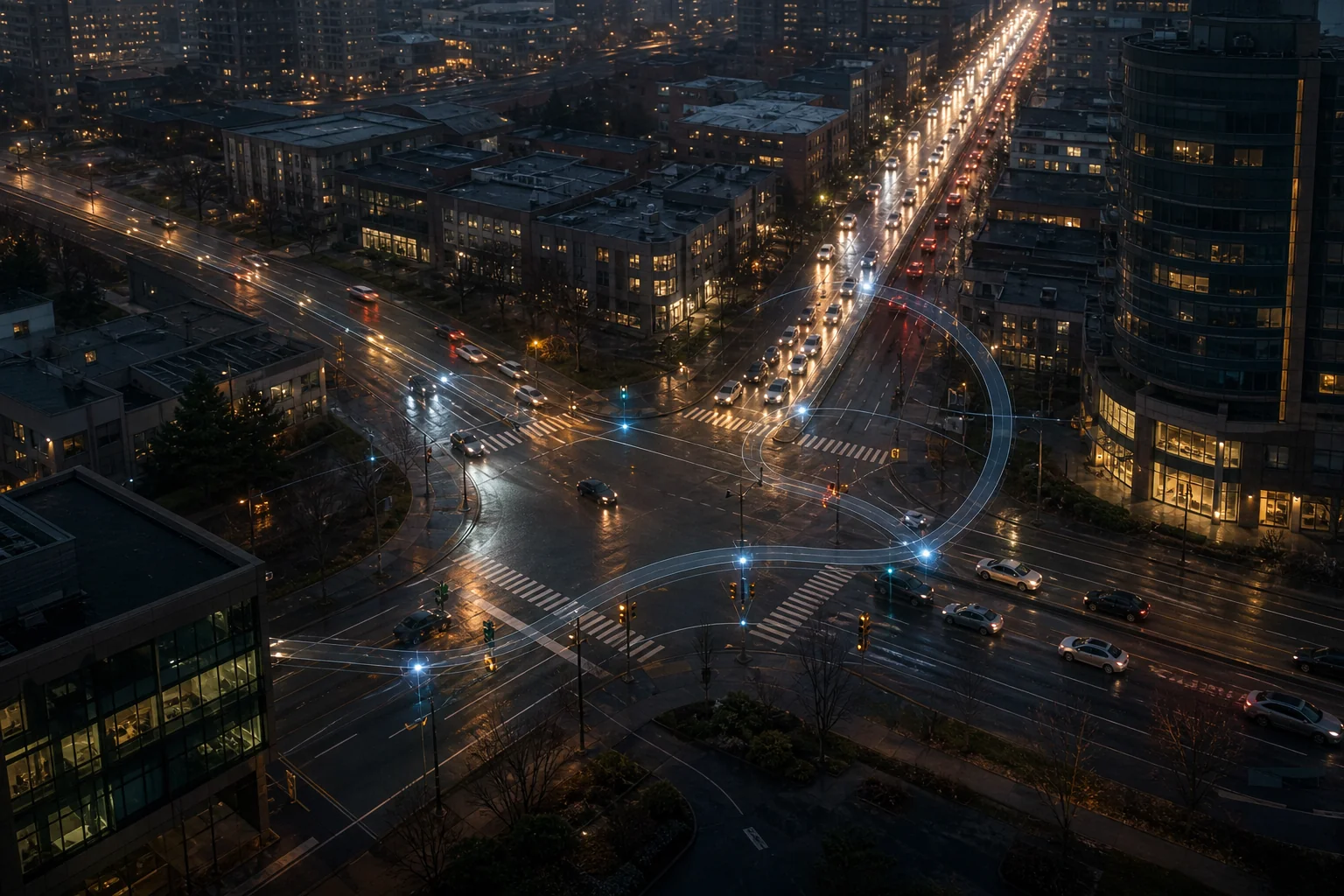
A traffic map can look orderly and still miss the real story. Two road sensors may sit side by side and behave differently, while streets far apart can rise and fall together as commuters flood in. PHGNet starts from that awkward fact. It does not force every relation into a one-to-one link; it groups pattern-similar nodes into hyperedges, so several sensors can move as a unit when the traffic pattern says they should. That matters because route planning, signal control, and urban traffic management all depend on the next few minutes, not just the next road segment. PHGNet targets that kind of messiness, where the shape of traffic can change from hour to hour.
When nearby roads stop agreeing
That shift pays off because spatial heterogeneity breaks the usual graph assumption. A normal graph says this road links to that road, but traffic often behaves more like a crowd: some nearby roads diverge, and some distant ones march together. PHGNet answers with prototype-guided hypergraph construction, which lets it gather pattern-similar nodes into higher-order groups that can change over time. The model also adds a global-local node representation module, so the grouping rests on features that stay consistent across time rather than on noisy snapshots. Then, for forecasting, it combines iterative residual refinement with Temporal Query Attention. Across multiple real-world datasets, PHGNet shows better predictive performance than state-of-the-art methods, which is the real test here: not a prettier network, but a model that reads the traffic system more like the system behaves.
How PHGNet builds moving groups
The trick is not just to build a bigger graph; it is to build the right groups at the right moment. PHGNet learns prototypes — pattern references that help it assign nodes to hyperedges when their traffic behaviour lines up. Because those groups can shift with time, the model also uses a global-local representation block to keep the signal stable enough to trust. On the forecasting side, iterative residual refinement lets one prediction update another, while Temporal Query Attention looks back across time in a way that still supports parallel decoding. That mix matters: the first part gives the model structure, and the second part turns that structure into a sharper forecast.
- Prototype learning assigns similar nodes to hyperedges instead of locking them into pairs.
- Global-local features keep those groupings anchored in time-consistent signals.
- Iterative residual refinement sharpens the forecast in stages.
- Temporal Query Attention helps the decoder read history while staying parallel.
“Despite significant progress, most existing methods are still limited to pairwise spatial dependency modeling, making it difficult to capture dynamic high-order interactions among nodes with similar traffic patterns.”
Why this changes traffic forecasts
For traffic operators, the appeal is practical. PHGNet targets route planning, signal control, and urban traffic management, all of which depend on forecasts that catch changing patterns instead of flattening them into pairwise links. A model that can group similar nodes at one moment and reshape those groups later is better suited to roads that do not behave like static wires on a map. PHGNet also keeps decoding parallel, so a sharper forecast does not have to come with a slower one. In plain terms, it tries to make the model match the city: many moving parts, connected in groups, with patterns that matter more than simple adjacency.
What to test next
PHGNet leaves one useful question hanging over the next round of tests: how well do its learned prototypes travel when the traffic network changes? A model that groups nodes by shared patterns should be strongest when those patterns repeat, but a new city, a different sensor layout, or a more chaotic rush hour could force the hyperedges to reorganize fast. That is the point to watch. PHGNet suggests traffic forecasting does not have to choose between local road links and broader group behaviour. If the group view keeps holding up, that older choice starts to look unnecessary.
Comments