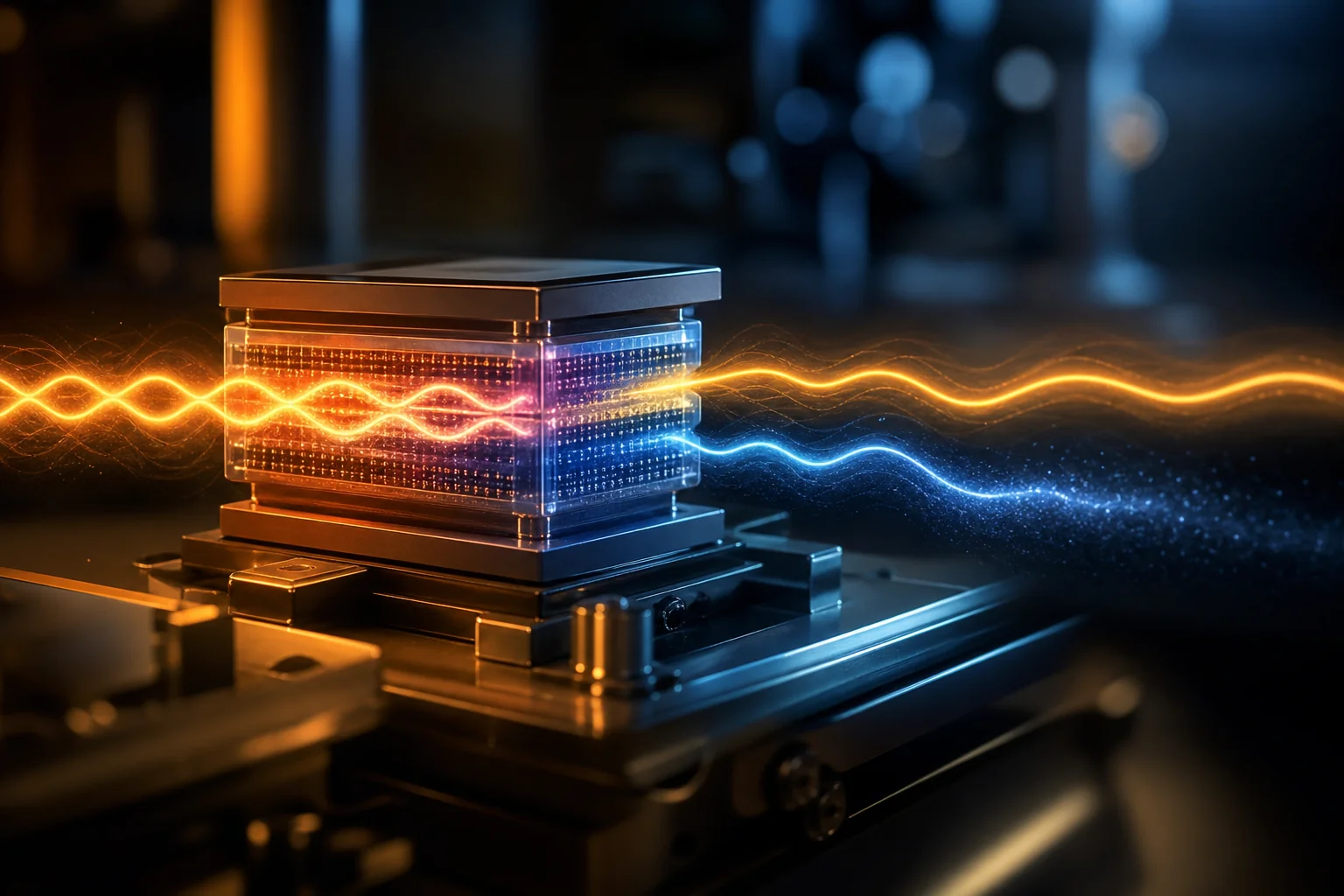
- Upper-band interference can lift conversion
- Lower-band interference can cut it
- Efficiency follows three different trends
- Multi-band cells need tuned transition rates
In a quantum dot photocell, the same quantum trick can be a helper or a hindrance. That matters because photo-generated carriers have to move through the device efficiently if light is to become electricity. This paper studies a quantum dot photocell with two intermediate bands, where carriers can travel through different charge-transport channels. The authors find that increasing the transition rates does not produce one simple trend: the photoelectric conversion efficiency first rises, then falls, and then falls monotonically. They also show that quantum coherence generated by the upper transition rates increases conversion efficiency because the interference is robust. By contrast, quantum interference induced by the two lower-transition rates reduces conversion efficiency, because it shortens the population lifetime in the intermediate bands. The takeaway is sharply practical for this narrow device model: quantum interference is not automatically beneficial. In a quantum dot photocell with multiple intermediate bands, the effect depends on which transitions create the interference.
A solar cell should turn light into current, not lose that energy on the way. That sounds simple. A quantum dot photocell makes the trip more complex. A quantum dot is a tiny piece of semiconductor material. A photocell is a device that turns light into electricity. In this paper, the twist is quantum interference, which means wave-like paths can add up or cancel out. The same trick can help or hurt. The opening surprise is that interference in this device does not have one clear effect. It can raise conversion, or it can cut it, depending on which transition makes it happen.
One device, three different efficiency trends
The model uses a quantum dot photocell with two intermediate bands. An intermediate band is a middle energy step between the main light-absorbing band and the band that carries current out. The abstract says the changing transition rates from different charge paths produce three trends. Photoelectric conversion efficiency first rises. Then it falls. Then it falls in a steady way. That split result is the paper's core finding. Upper transition rates create quantum coherence, which means shared wave timing between states. That coherence brings robust interference, and efficiency goes up. Lower transition rates do the opposite. They shorten how long carriers stay in the middle bands. Once that life span shrinks, the cell has less chance to move useful charge onward.
How the interference was sorted out
The study asks a sharp question. Which kind of interference helps, and which kind hurts? To answer it, the model tracks charge transport through the upper and lower transitions in the two-band design. Charge transport means the motion of photo-made carriers, such as electrons, through the cell. The key idea is that the same wave effect can act in two places at once. In one place, it supports flow. In another, it cuts the time carriers spend in the middle. That is why the paper treats the upper and lower rates as separate levers. Once those levers move, the efficiency curve no longer behaves in a single, simple way.
- Upper transition rates create robust interference and raise conversion.
- Lower transition rates shorten the stay in the intermediate bands.
- The efficiency curve can rise, fall, and then fall in a steady way.
“It is generally believed that quantum interference can improve the transport of photo-generated carriers in a photocell, thereby improve the photoelectric conversion efficiency.”
“The same quantum trick can be a helper or a hindrance.”
Why this matters for future cell design
The useful lesson is not that interference is good or bad. It is that its value depends on where it acts. That matters for any quantum dot photocell with multi-intermediate bands. The paper points to a practical design rule. Adjust the interference, do not assume it will help on its own. If the upper transition channels dominate, coherence can support better photoelectric conversion. If the lower transition channels dominate, the middle bands lose carriers too fast. The result is a clear warning for device design. More quantum mixing is not always more useful current.
What to test next
The paper ends with a concrete hope. It suggests artificial ways to reach efficient photoelectric conversion by tuning quantum interference in multi-intermediate-band quantum dot photocells. The next useful test is whether that rule still holds when more middle bands are added. Another open question is how to balance the upper and lower transition rates in a real device. This paper does not claim a finished solar cell. It does give a sharper map of the trap. In this kind of cell, the wrong interference can drain the very carriers you wanted to save.
Comments